
Champions Cup Rugby Betting: Pool Format and Knockout Markets
 Available in US
The Champions Cup has cost me more pre-match value bets than any other rugby competition I have priced. The reason is simple and uncomfortable to admit: English clubs travelling to France in pool stages behave differently from how their form lines suggest, and I underestimated that for several seasons before the pattern became impossible to ignore. The Investec Champions Cup is, in my view, the most regularly mispriced European rugby competition for British punters who model from Premiership form alone.
The competition’s structure mixes top sides from the Gallagher Premiership, France’s Top 14, and the United Rugby Championship into a pool stage that funnels into a knockout bracket. The pool format and the knockout mechanics create distinct betting environments, and treating them with the same analytical approach is the first mistake to avoid.
This guide covers the pool stage format and seeding logic, how knockout bracket pricing works, the league-by-league trends that move European matches, the realities of away-day difficulty, and what to watch for as the final approaches.
Pool stage format and seeding
The Champions Cup pool stage involves twenty-four clubs split into pools of four, with each side playing four pool matches (two home, two away) before the round of sixteen begins. Seeding is determined by the previous season’s domestic league position, which means the top sides from Premiership, Top 14, and URC are spread across the pools to balance strength on paper.

For betting purposes, the seeding logic creates a tiered field. The top seeds in each pool are expected to qualify for the knockout. The bottom seeds are usually playing for pride and bonus points. The middle seeds are where the betting interest concentrates because their qualification fate is genuinely uncertain across the four pool matches.
Pool standings carry through to knockout seeding, so a pool win matters not just for qualification but for the knockout draw. A side that finishes top of its pool gets a more favourable bracket; a side that scrapes through in eighth place faces a top seed from another pool in the round of sixteen. This makes the final pool round high-stakes in a different way than the earlier rounds: a knockout-bound side might rest stars in a meaningless final pool match, while a side fighting for seeding plays its strongest XV. Reading squad rotation correctly in the final pool round is one of the most profitable bits of analytical work in European competition.
Premiership audiences have grown over the past two seasons. The 2024/25 Premiership season saw average TV audiences rise around ten per cent on the previous year, and Premiership matches scheduled in the Saturday slot after Premier League football enjoyed a forty-seven per cent audience boost. The same English clubs and players feature in Champions Cup, and that growing engagement informs how heavily Premiership-side fixtures are bet – and therefore priced – in European competition.
Knockout bracket betting mechanics
Once the knockout begins, the bracket structure becomes the dominant pricing input. The round of sixteen is single-leg with the higher-seeded side at home. Quarter-finals are single-leg, also with the higher seed hosting. Semi-finals are single-leg at neutral venues, with the final at a designated neutral stadium.

The home/away split in the round of sixteen and quarter-finals creates a structural home advantage that the market prices in but does not always price correctly. Top seeds at home tend to convert at a high rate, but the rate is not high enough to justify the short prices the public bets them at. Underdog away sides covering the handicap is one of the more profitable patterns I have backed in European competition.
The semi-final and final at neutral venues are different again. Without the home crowd, the matches usually narrow on the handicap. Pre-match handicap lines of seven or more for the favourite at a neutral venue in a Champions Cup semi-final have historically been generous on the underdog side, especially when the underdog has battle-hardened form from domestic competition.
Outright winner markets open the day after the previous final and run through the entire pool stage. The prices on the established powerhouses (Toulouse, Leinster, La Rochelle, the leading English sides in any given year) tend to settle quickly and offer limited value pre-tournament. Mid-tier French and English clubs sometimes carry generous outright prices into the early pool rounds when their early form is uncertain; tracking those prices through the pool stage can identify value windows. For the deeper mechanics of how outright tournament prices behave through a competition, see my guide to outright tournament winner betting in rugby.
English vs French vs Irish clubs trends
The Champions Cup has historically been dominated by French clubs (Toulouse, La Rochelle, Toulon, Clermont) and Irish provinces (Leinster, Munster, Ulster). English clubs have had stretches of dominance but the last five seasons have skewed toward French and Irish winners.

The trend lines for betting purposes are tactical. French Top 14 clubs play a forward-led, structured game that travels well to neutral venues and dominates set-piece-heavy semi-finals. Irish provinces (especially Leinster) play a phase-heavy, well-coached game that converts in knockout rugby. English Premiership sides have historically been more variable in European competition: capable of beating any side at home but vulnerable to away travel in pool stages, particularly to French opponents.
The away-from-home factor for English clubs is the single most important pattern I track. English sides travelling to France in pool rounds have consistently underperformed bookmaker expectations, partly because of the long travel, partly because of the climatic shift in late autumn and early winter, and partly because of the unique atmosphere French rugby crowds generate.
Simon Massie-Taylor, CEO of Premiership Rugby, captured the engagement momentum in English rugby when he noted that he was delighted to see over 700,000 additional viewers and more than 21,000 more supporters buying tickets to watch the opening exchanges of the Gallagher Premiership. That domestic momentum has translated into stronger Champions Cup market liquidity around English clubs, but the underlying performance pattern on European away days has not yet caught up with the betting volumes. The mispricing window for English-side underdogs at French venues remains open.
Away-day difficulty and odds
Away days in the Champions Cup are not equal. A trip from Exeter to Pau is a four-hour flight, a coach transfer, and an unfamiliar climate. A trip from Bristol to Castres is comparable. A trip from Bath to Limerick is shorter logistically but no less intimidating culturally. The bookmaker prices in some of this but the discount is rarely sufficient.

The pattern I have backed repeatedly is the underdog plus the handicap when an English Premiership side travels to a top-tier French away venue. The favourite covers the handicap less often than the public assumes, partly because French clubs at home routinely produce performances above their domestic form, and partly because away English sides routinely produce performances below their domestic form. The combination of both shifts means the line is consistently too generous to the favourite.
Irish provinces travelling within the URC ecosystem (to Scotland, Italy, South Africa) face different away challenges. The South African travel for URC sides has its own dynamic in Champions Cup pool stages, where altitude and long-haul recovery become factors. The bookmaker prices these correctly more often than the English-to-France pattern, but the underdog plus handicap remains worth considering.
Champions Cup final betting notes
The Champions Cup final is one of the most heavily bet club rugby fixtures of the year in the UK. Liquidity is deep, prices are sharp, and edge in headline markets is hard to find. The interesting markets are the secondary ones: first try scorer, winning margin bands, total tries, half-time/full-time doubles.
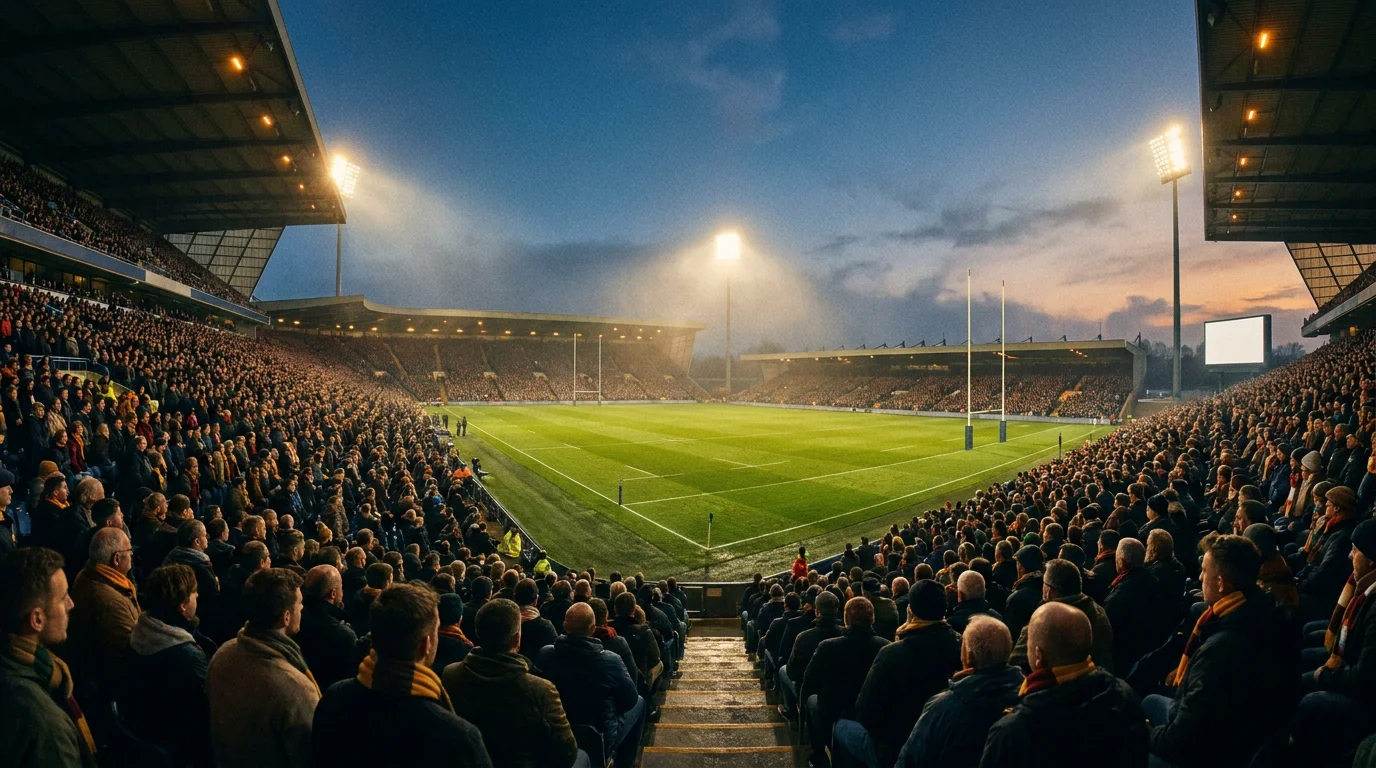
Final venues vary year to year. Aviva Stadium in Dublin, Tottenham Hotspur Stadium, Old Trafford, and various French venues have hosted recent finals. The venue choice affects pre-match pricing because it implicitly favours one side’s travelling support and atmospheric advantage.
The URC competition’s overall attendance momentum is also worth noting as context. The URC 2025/26 season generated total attendance around 1.62 million with an average of just under eleven thousand per match, and a single fixture (Stormers versus Bulls) drew 53,682 spectators. That URC infrastructure feeds directly into Champions Cup competitiveness because the URC provinces and the South African franchises bring battle-tested squads into European competition. Pricing URC sides as European underdogs is sometimes generous in a way that the bookmaker has not fully corrected.
My final word on Champions Cup final betting: respect the form line from the knockout rounds, not the pool stage. A side that has battled through two single-leg knockouts to reach the final has earned a different pricing profile from a side that cruised through a soft pool group. The market sometimes does not adjust enough.
