Rugby World Cup 2027 Betting: Format, Odds and Long-Term Outlook
 Available in US
I had the December 2025 RWC 2027 draw on a second monitor while a Premiership match played on the first. The draw came out of Sydney, the pools landed on screen, and within about 45 minutes the first revised futures prices were live across UK books. That window — pool reveal to first repriced futures — is one of the cleanest market moments in rugby. Before the draw, books were guessing at strength of schedule. After the draw, the path is concrete. The price gap between those two states is real money for the bettors who watch it close.
The 2027 World Cup in Australia is the first edition of a substantially different tournament. Twenty-four teams instead of 20. Six pools of four. Fifty-two matches instead of 48. A brand new Round of 16. The format change isn’t cosmetic. It rewires how pool-stage betting works, opens an entirely new market for knockout-bracket bets, and changes the value calculus for outright futures held from now until the final in October 2027.
This is a futures-heavy guide because that’s the betting market that’s actually open right now. There are no fixtures to handicap, no in-play decisions to make. There are decimal odds on outright winners, top try scorers, pool winners, and a growing catalogue of bracket-style markets. Those odds will tighten substantially as we move through the Six Nations 2026, the autumn internationals 2026, and the warm-up matches in early 2027. If you want to take a position on the trophy, the price you pay now is meaningfully different from the price you’ll pay 18 months from now — usually worse, sometimes better.
What follows is how I’m thinking about it: the new format and its betting implications, pool-stage market mechanics, the Round of 16 layer, the current outright snapshot, contender form, futures strategy, and the commercial and attendance context that frames the whole thing. I’ll keep the contenders analysis grounded in current data rather than predicting the future, because that’s the bet’s job — not mine.
The new 24-team format, explained for bettors
The first thing to internalise: this is a different tournament. Not a tweaked version of 2023. Different in ways that matter for every market on the board.
Rugby World Cup 2027 expands from 20 to 24 teams, splits them into six pools of four, plays 52 matches across the tournament, and introduces a Round of 16 between the pool stage and the quarter-finals. That last point is the structural change with the biggest betting consequences. In every World Cup from 1987 to 2023, the top two teams from each pool went directly to the quarter-finals. In 2027, the top two from each pool plus the four best third-placed sides advance to a Round of 16. Sixteen teams in a knockout bracket, not eight.
Translate that into market language: there’s now a layer of knockout fixtures that didn’t exist before, with its own betting markets. Round of 16 winners, Round of 16 handicap, Round of 16 total points — all live as separate pricing exercises. The bracket is fixed once the pool stage finishes, which means each Round of 16 fixture becomes a discrete trading product for a 72-hour window before kick-off.
The format also lowers the cost of a single bad pool result. In 2023, a top-tier side losing one of their three pool matches could easily miss the knockout stage. In 2027, with 16 teams advancing, the top-tier sides have effectively three lives in the pool stage — they’d have to lose two of three to risk elimination. That changes the pool match-winner markets significantly. The bottom-tier sides have less to gain from upsets, and the top-tier sides have more freedom to rest players in the third pool match. Expect rotation. Price it in.
One subtlety the public underrates: the four “best third place” slots are decided on points difference within the pools. That means even pool matches that don’t change the top-two standings still matter for the bracket — and for the futures markets. A side topping their pool by 30 points instead of 15 takes a measurably easier Round of 16 fixture, which then translates to a shorter futures price. The chain runs from individual match results to ultimate outright value, more directly than in any previous edition.
Pool-stage betting mechanics under the new structure
The pool draw produced predictable outrage on social media — there’s always one — but for betting purposes, the pool structure is information, not opinion. Six pools, four teams each. Two top seeds, two second seeds, two third seeds, and so on across the seeding bands. The strength of pool varies, but the predictability of pool-winner markets actually went up under the new format because the gap between the top seed and the rest of the pool is wider on average.
Pool winner markets are now priced shorter than they were in 2023, with top seeds typically between 1/8 and 1/3 for their pool. That tells you where the public money goes and where it doesn’t. The interesting pool-winner bets are usually in the pools containing two genuinely strong sides — a “group of death” pool where the top-seed price is closer to even money. Those are rare under the new seeding, but they do happen, and when they do, the second seed at 5/2 or 3/1 is often genuinely playable.
The pool-stage match-winner markets are where rotation risk lands. A top-tier side that’s already qualified after two matches will rotate heavily in match three. UK books usually move the line in the 48 hours before kick-off as starting lineups are confirmed. The smart play is to wait for team news, not bet the morning of. I have a folder of bets I would have made before team news that subsequently looked terrible after the named XV showed eight changes. The pool-stage third-match window is when patience pays.
Pool-stage handicap betting is the most efficient of the pool markets, because the line is set off the rating gap and adjusted lightly for venue and rotation. The pool-stage totals — especially total tries — are the softer markets. Why? Because mismatches in a 24-team field are larger than in a 20-team field. A first seed against a fourth seed in a four-team pool produces try totals that can run from 8 to 12+, and books are conservative on the over because they price for variance. Selectively, the alternative tries totals line on first-seed vs fourth-seed pool matches is one of the cleaner edges in the early tournament.
Round of 16 knockout markets, a new betting layer
Twelve sides have qualified directly from pool top-two finishes. Four more enter as best-thirds. The bracket pairs pool winners against either second-place sides or best-thirds, in a configuration that’s fixed in advance but resolves only when the pool stage finishes. Knockout, single match, golden-point extra time if level after 80 minutes.
From a betting perspective, this is a fixture window that no UK bettor has experience pricing at the World Cup level. The closest reference is European club rugby’s Round of 16 — which the URC and Champions Cup have produced in various forms — but international rugby doesn’t have a direct comparable. That information vacuum cuts both ways. Books are pricing off pool-stage form plus their pre-tournament ratings, which means they’re sensitive to surprise results. So is the public.
The pricing in the 72 hours before each Round of 16 match will look like a smaller European playoff. Match-winner, handicap, totals, try scorers — the usual catalogue. The market depth will probably be tighter than for quarter-finals at previous tournaments, because volume is split across eight Round of 16 matches in 72 hours instead of being concentrated on four quarter-finals over a longer window.
The Round of 16 markets I’d watch most closely are the handicap lines on top-seeded pool winners against best-thirds. Best-thirds are by definition the four weakest qualifying sides, but they got there by scoring points and winning at least once. The narrative will be that they’re cannon fodder. The actual handicap line will rarely justify that — I’d expect lines in the -15 to -25 range, which is wide and full of variance. The unders on the handicap in those games are more interesting than the favourites’ moneyline.
Outright winner odds snapshot, post-draw
Sam Rosbottom at Betfair laid the post-draw outright picture out neatly: “South Africa are 9/4 favourites to win the Rugby World Cup for a third successive time in 2027. The Boks have cemented their position as World No.1 and are likely to collide with 7/2 second-favourites New Zealand.”
Behind those two: France at 9/2, England at 5/1, Ireland at 6/1, Australia at 9/1 (with home advantage already priced in), and the rest at double-digit prices. Wales, Scotland, Argentina, Italy and the second-tier sides start at 25/1 or longer — usually much longer.
What that price ladder tells you about market structure: the bookmakers see five genuine contenders (South Africa, New Zealand, France, England, Ireland) and one host nation playing for outsider status (Australia at 9/1). The implied probabilities work out to roughly 30 percent South Africa, 22 percent New Zealand, 18 percent France, 17 percent England, 14 percent Ireland, 10 percent Australia. Those add to over 100 because of overround — about 11 percent in current futures markets, which is normal for an event this far out.
The interesting feature of the current price ladder is that South Africa, at 9/4, is one of the shortest pre-tournament favourites in modern Rugby World Cup history. The last time a side opened this short was probably New Zealand pre-2015. There’s a case for that price — back-to-back titles, World No.1 ranking, peak Rassie Erasmus era — but historically, shorter favourites have been priced tighter than they should have been. A 9/4 Springboks side has roughly a 30 percent implied probability. That’s the floor for the favourite at this point in the cycle. It probably contracts to 5/2 or 11/4 by kick-off Round 1 of the Six Nations 2027, then to 7/4 or thereabouts by the start of the tournament.
For context on what kind of return that implies: backing South Africa now at 9/4 on a £100 stake returns £325 if they win. Backing them at 7/4 in mid-2027 returns £275 on the same stake. The difference is £50 per £100, or roughly 18 percent additional return for being right early. That premium is the question every futures bettor has to answer: is the value worth the time-value-of-money trade-off and the risk of a key injury before kick-off?

Contenders form analysis heading into 2026
Form analysis for an event 18 months away is a different exercise than form analysis for next weekend. You’re not trying to predict the matchday performance — you’re trying to predict the side’s trajectory through 18 to 22 months of rugby. That includes Six Nations 2026 and 2027 for the European sides, the Rugby Championship 2026 and 2027 for the southern hemisphere sides, the autumn internationals in both years, plus the warm-up matches in early 2027.
South Africa at 9/4 are a side whose ceiling is established and whose floor is high. The variance on the Springboks is unusually narrow. They don’t have many bad days, and when they do, the loss is rarely by 15+ points. That narrow variance is what justifies the short price. The risk to the bet is injury to specific players — the front row and the fly-half position are the load-bearing positions in the current squad, and a single key injury six weeks before the tournament could move the price meaningfully.
New Zealand at 7/2 are the side with the longest historical claim and the most uncertain current state. The All Blacks of 2019-23 weren’t the All Blacks of 2011-15, but the squad rebuild has been progressing. They’ll either come into the tournament as legitimate joint-favourites or fade to 9/2 after a poor southern hemisphere season. The two-way price movement is what makes them interesting as a futures position. There’s no obvious narrative arc to lock the price.
France at 9/2 are the home-shy side of the top tier. They’ve underperformed at consecutive World Cups despite being formidable in Six Nations weekends, and the squad’s at the back end of a cycle that peaked around 2022-23. The current price prices in the underperformance pattern. If the next 18 months see a generational reset, that 9/2 could look generous in hindsight.
England at 5/1 are the floor-and-ceiling side. The floor is “competitive quarter-finalist.” The ceiling is “winner with a generational fly-half performance.” The 5/1 price prices in mostly the floor with a sliver of ceiling. The bettor’s job is to decide whether England’s actual ceiling is higher than the market currently thinks.
Ireland at 6/1 are the most interesting price on the board. Ireland has been ranked World No.1 multiple times in the last cycle and has the squad depth and coaching continuity to be a genuine contender. The 6/1 reflects their World Cup track record — they’ve never made a semi-final — more than their current strength. That’s a futures bettor’s classic question: does past failure properly inform future probability, or is the market overweighting a historical pattern that the current squad has the tools to break?
Australia at 9/1 are the host nation premium. Home advantage at a World Cup is real but not huge — historically worth maybe 10 to 15 percent on implied probability. The 9/1 has the home premium baked in. Without it, Australia would probably be 14/1 or longer. If you’re betting on Australia, you’re betting on the home crowd plus the natural draw quirks (slightly easier knockout path for the home side, in most editions). That’s a viable thesis. It’s also a thesis with no proof until the tournament starts.

Futures betting strategy for an 18-month horizon
Rugby Vision, the algorithmic model that runs probability-based predictions on rugby fixtures, posted an average prediction error of under six points per match across 48 Rugby World Cup 2023 games. That’s sharper than typical bookmaker pre-game lines and suggests that algorithmic approaches can compete with — and sometimes beat — market pricing at the World Cup level. The implication for futures betting is that there’s room for an evidence-based futures strategy that doesn’t depend on insider information.
The strategy I use for World Cup futures runs along three axes. First, identify the structural price floor for each contender: the price below which the favourite cannot reasonably trade given variance, injury risk, and 18 months of rugby to play. South Africa’s floor is probably 7/4. Above that, there’s room to drift, but below it, the price is already saying “the tournament’s about to start.” Second, identify the structural narrative drivers — Six Nations 2026 and 2027 for European sides, Rugby Championship for southern, autumn internationals for everyone. Each event repositions the futures market for two to four weeks afterwards. Third, identify the asymmetric futures positions: bets that win big if a specific narrative unfolds and lose small if it doesn’t. Best try scorer markets, top point scorer markets, and pool-winner-plus-quarter-final-double bets all fall into this asymmetric category.
The mechanical question of “when to bet” has a more nuanced answer than for short-term markets. Futures pricing has its own seasonality. Books reduce overround in the weeks immediately after major events because the public engages and they want the volume. They tighten overround when public attention drifts. The cleanest overround windows I’ve found for World Cup futures are: the two weeks immediately after Six Nations finals; the week of the southern hemisphere Rugby Championship final; and the 48-hour window after each autumn internationals window closes.
For the deeper mechanics of how I evaluate edge, build position size, and assess whether a futures bet survives variance, the breakdown of value betting on rugby in depth walks through the math and the worked examples. The principles transfer directly to World Cup futures with one adjustment: variance is higher, sample is smaller, and the discount rate on tied-up bankroll is real.
Commercial and attendance context for the 2027 event
The economic shadow of a Rugby World Cup is large enough to affect betting markets indirectly through media coverage, audience growth, and the gravitational pull on the calendar around it. The 2023 edition gave us baseline data: the sponsorship portfolio comprised 38 brands with a combined annual value of about $143.75 million, and ticket sales returned approximately $233.08 million from tickets priced between $40 and $1,036.
For 2027, the host association in Australia is already projecting an expanded commercial scale on the back of the 24-team format and 52-match schedule. More matches means more inventory for broadcasters, more ticket categories, and a longer window of audience engagement. From a betting market perspective, that translates to more secondary markets, longer trading windows for each fixture, and higher liquidity on the major matches.
The audience-growth narrative also matters because UK rugby betting volume tracks media coverage with surprising fidelity. Heavy coverage on UK channels drives volume into UK-licensed bookmakers, which drives liquidity in the markets, which drives tighter prices on the public-money matches and softer prices on the longer-tail markets. The English-language broadcast deal for RWC 2027 will be one of the most-watched commercial announcements in the run-up to the tournament. Track it.
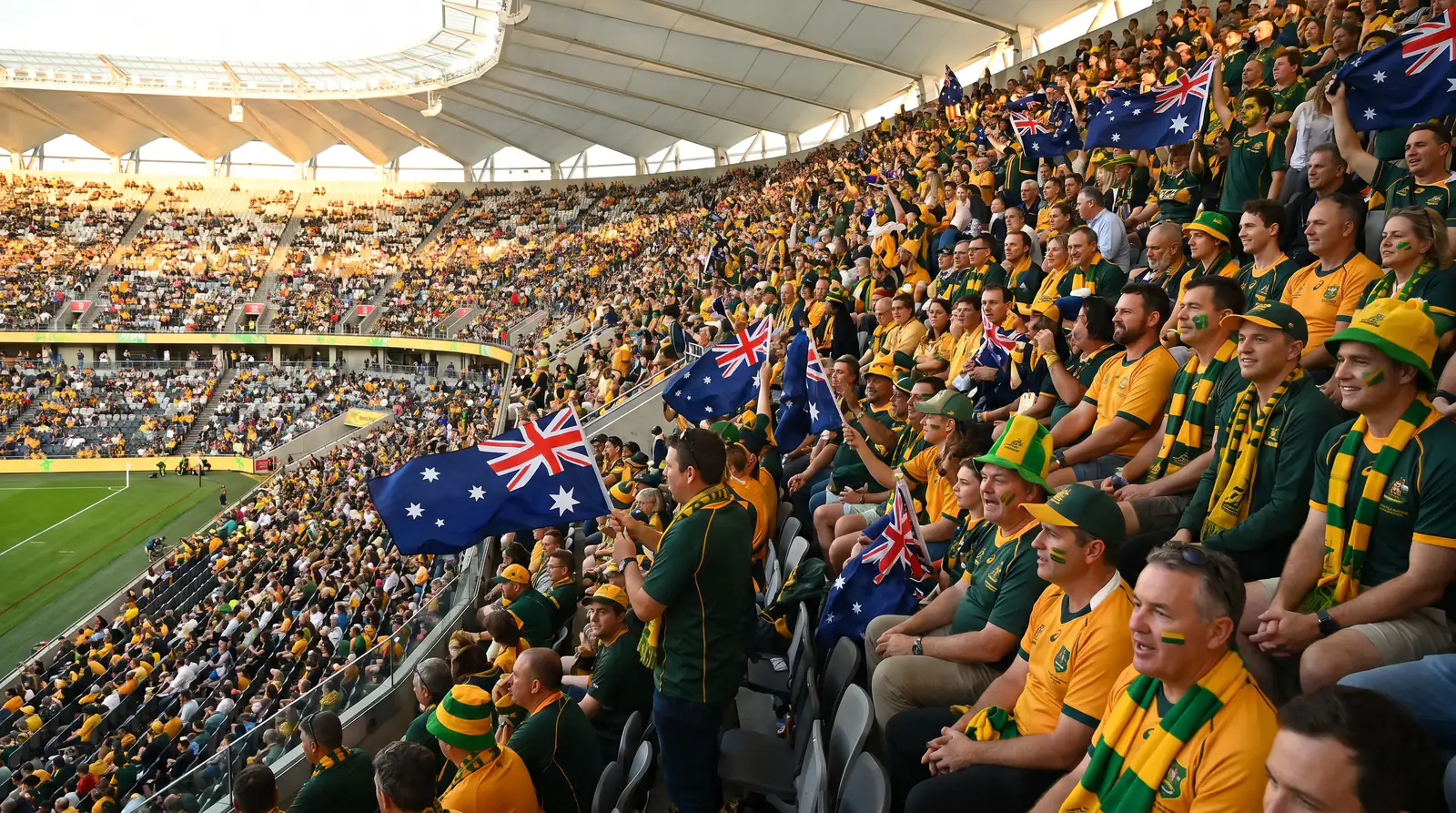
One specific consequence of expanded ticket inventory: more pool-match audiences in stadium means more in-person engagement and louder crowd noise, which marginally favours home and host-nation sides. That’s a small effect, measured in low single-digit percentage points on win probability, but it compounds across multiple matches. For Australia at 9/1, that compound effect is part of why the 9/1 is justified.