
Decimal vs Fractional Odds for Rugby: Conversions and Why It Matters
 Available in US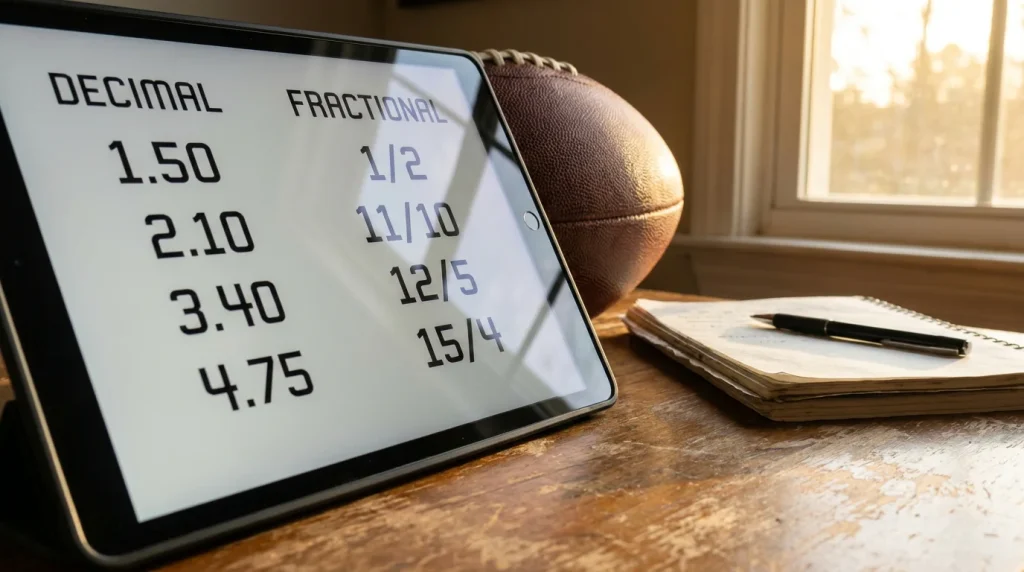
I once watched a friend stare at a rugby coupon for ninety seconds trying to decide if 9/4 was better or worse than 3.20. He was an accountant. He just had never bothered to translate between the two formats because his usual book was set to fractional and his maths brain had never been asked to translate quickly. That moment convinced me that fluency in both odds formats is one of the small skills that separates the comfortable bettor from the one who hesitates and misses the price.
British rugby books default to fractional odds for tradition’s sake, but every European and exchange-side competitor uses decimal. If you bet across more than one operator – and most serious British punters do – you need to read both formats automatically. This is a short guide to making that happen.
How each format actually reads
Fractional odds tell you the profit on your stake, not the total return. A bet at 9/4 returns nine units of profit for every four staked, plus your stake back. A successful £40 bet at 9/4 returns £130 (£90 profit plus £40 stake). The fractional convention reads cleanly when the numbers are small and the maths is mental: 5/1, 7/2, 2/1, 11/4. It gets uglier with awkward prices like 100/30 or 33/20.

Decimal odds bundle the stake into the return figure. A bet at 3.25 returns 3.25 units total per unit staked, meaning 2.25 units of profit plus the stake. A successful £40 bet at 3.25 returns £130 – exactly the same outcome as 9/4 above, just expressed differently. The decimal format makes accumulator maths simple (multiply the decimals together) and reads cleanly across any odds, including very short prices like 1.18 or 1.05 that look ugly in fractional (5/28 or 1/20).

The decimal format also handles odds-on prices intuitively. A 1.40 favourite is obvious; a 2/5 favourite requires you to remember that fractional reverses for odds-on. This is one of the practical reasons sharp punters favour decimal once they bet seriously: it removes the cognitive overhead of mentally flipping fractions.
Conversion table and formulas
The conversion formula is straightforward. To go from fractional to decimal: divide the numerator by the denominator and add one. So 9/4 becomes (9 / 4) + 1 = 3.25. So 5/1 becomes 6.00. So 11/10 becomes 2.10.

To go from decimal to fractional: subtract one, then express the remainder as a fraction. So 3.25 becomes 2.25, which is 9/4. So 1.40 becomes 0.40, which is 2/5. So 5.50 becomes 4.50, which is 9/2.
For mental shortcuts, memorise the common prices and their equivalents. Evens equals 2.00. 6/4 equals 2.50. 2/1 equals 3.00. 5/2 equals 3.50. 3/1 equals 4.00. 7/2 equals 4.50. 4/1 equals 5.00. 9/2 equals 5.50. 5/1 equals 6.00. 6/1 equals 7.00. 10/1 equals 11.00. Once these are automatic, the unusual prices (100/30, 13/8, 11/10) become recognisable as small adjustments from the standard anchors.
Real-world example: after the December 2025 draw for the 2027 Rugby World Cup, Betfair priced South Africa at 9/4 for the outright (decimal 3.25), New Zealand at 7/2 (decimal 4.50), France at 9/2 (decimal 5.50), England at 5/1 (decimal 6.00), Ireland at 6/1 (decimal 7.00), and Australia at 9/1 (decimal 10.00). If your default is fractional, those numbers read instantly. If your default is decimal, the same prices land just as cleanly. The skill is reading both without conversion lag.
Implied probability and overround
The deeper reason to think in decimal is that it gives you implied probability directly. Implied probability equals 1 divided by the decimal price. So 3.25 implies a probability of 1 / 3.25 = 30.8 per cent. So 1.40 implies 71.4 per cent. So 5.00 implies 20 per cent.

Add up the implied probabilities of every outcome in a market and you get the overround – the total above 100 per cent that represents the bookmaker’s margin. A two-way match-winner market with prices of 1.95 and 1.95 implies 51.3 per cent on each side, totalling 102.6 per cent. The 2.6 per cent above 100 is the bookmaker’s margin. A three-way market with draw included has more probabilities to add up, and the overround usually sits a bit higher, around 105 per cent for typical rugby match three-way markets.
The overround tells you immediately how aggressively the market is priced. A Six Nations match-winner market at 102 per cent total implied probability is cheap to enter; a futures market at 130 per cent is expensive. The wider the overround, the more your true edge has to be just to break even.
This connects directly to the bigger picture of bet quality. The UK gambling industry generated £4.5 billion in gross gambling yield during Q4 2025 alone, and the share that comes from sports betting reflects how heavily punters wager into markets they have not actually beaten. Reading overround is the simplest way to start filtering which markets are worth your stake and which are not.
For a fuller treatment of how prices move from open to close and why beating the closing line is the strongest single signal of long-term betting quality, see my guide to closing line value in rugby betting.
Why fractional still dominates UK rugby
British bookmakers retain fractional odds as their default for two reasons: cultural inertia and customer preference. Most casual British punters read fractional naturally because that is how prices have always been displayed on UK racecards, on football coupons, and on rugby boards. Switching to decimal is offered as a toggle, but the default sticks.

There is also a marketing element. Fractional prices like 5/1 sound bigger and more dramatic than 6.00. A 25/1 outright reads with more emotional punch than 26.00, even though they are mathematically identical. Bookmakers benefit when long-shot bets feel more rewarding than they really are.
The practical advice is simple: switch your account display to decimal, or train yourself to read both formats automatically. Decimal makes overround visible, makes accumulator maths quick, and removes the odds-on flip from your mental load. Fractional remains the lingua franca of the British rugby coupon, so you still need to read it. Treating both as equally native is the small efficiency that pays itself off across thousands of bets.
One last tactical note. Some UK bookmakers display fractional but settle in decimal precision, which means a price of 11/10 on the board might pay 2.10 exactly even though 11/10 simplifies to 2.10 only by convention. Edge cases at split fractions (like 9/4 versus 9/4 split with 11/4) can create one-or-two pence differences on a large stake. The discipline of comparing two operators in the same format prevents most of these small errors.
